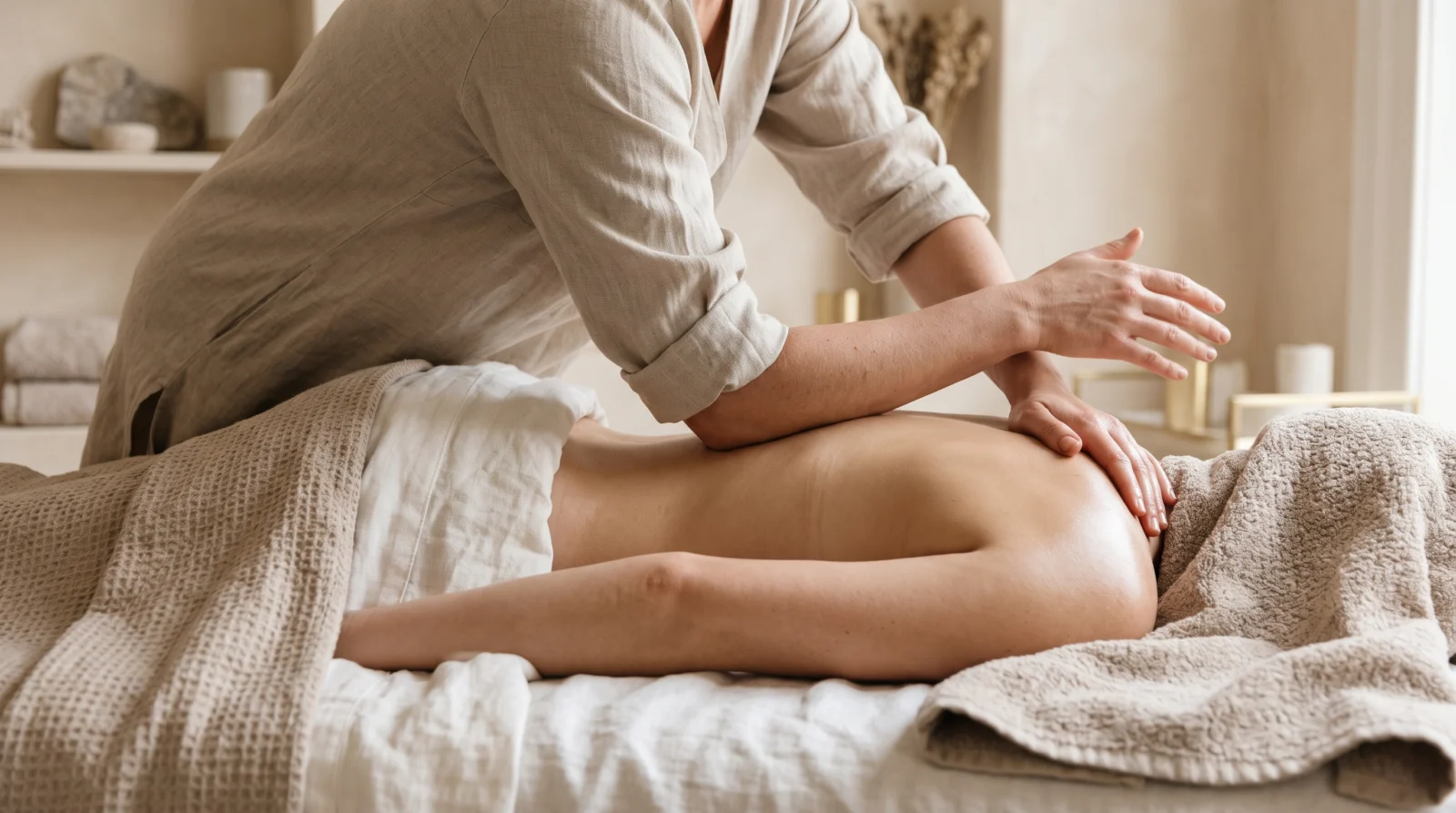
If your shoulders seem to live up near your ears, or the same tightness in your lower back has been with you for months, a gentle massage may not feel like enough. That’s usually when people start asking about deep tissue massage. This guide explains what it involves, how it differs from a Swedish massage, what happens in a session and how to look after yourself afterwards, so you can decide whether it’s right for you.
What is deep tissue massage?
Deep tissue massage uses firm, sustained pressure and slower strokes to work into the deeper layers of muscle and the connective tissue around them. Rather than gliding over the surface, your therapist concentrates on particular areas, often the neck, shoulders, upper back and lower back, using hands, forearms and sometimes elbows.
It is a focused treatment rather than a purely relaxing one. Many people still find it calming and leave feeling looser, but the aim is to work steadily on areas that feel tight or restricted.
Deep tissue or Swedish: what’s the difference?
Both use similar strokes. The difference is in pressure and intent.
- Swedish massage uses lighter, flowing pressure for general relaxation. It suits you if you want to unwind and don’t have one particular area bothering you.
- Deep tissue massage uses slower, more concentrated pressure on specific areas of tension.
A simple way to decide: if you can point to the exact spot that bothers you, deep tissue is usually the better match. If you’d simply like an hour of calm, Swedish is the gentler choice. Not sure? Tell us when you book and your therapist will talk it through at your consultation.
Who tends to choose it?
You don’t need to be an athlete. People who book deep tissue massage often include:
Runners and gym-goers who want firmer work on tired muscles
Anyone who carries long-standing tightness in the back
People who prefer a firmer massage in general
If you’re having treatment for an injury, it’s worth mentioning it to your therapist and, where relevant, checking with your physiotherapist or GP first. Massage isn’t a substitute for medical treatment.
What happens during a session at Artisa Spa
Every deep tissue massage follows a similar shape, adjusted to how you feel on the day.
- A short consultation. Your therapist asks about the areas you’d like worked on, any past injuries and any health conditions they should know about.
- Warming up. The first few minutes use lighter pressure to warm the muscles and find where the tension sits.
- Focused deep work. Your therapist works methodically through the tighter areas with slow, firm strokes, checking the pressure with you as they go.
- Finishing. The massage eases off with lighter strokes, and some sessions include gentle stretches.
- Aftercare. You’ll get simple advice on what to expect over the next day or two.
Arrive about 10 minutes early so you can settle in and go through your consultation calmly.
Pressure: you’re always in control
Deep tissue massage shouldn’t hurt to work. Good deep work feels firm and can feel intense on a tight spot, but it should never be sharp or make you hold your breath. Say if the pressure needs changing at any point. A quick word is completely normal, and your therapist would always rather adjust than have you put up with discomfort.
Choosing a length
Deep Tissue Massage can be booked for 30, 45, 60 or 90 minutes.
| Length | Good for |
|---|---|
| 30 minutes | One focused area, such as the back, neck and shoulders |
| 45 minutes | One or two areas without rushing |
| 60 minutes | A full-body massage with time on the areas that need it most; a good first booking |
| 90 minutes | Unhurried full-body work with extra time on stubborn areas |
Current prices for each length are on our deep tissue massage page, our massage page and in the booking form. If you’d like deep tissue combined with something else, our fusion massages pair it with hot stones or with an Indian head massage in one appointment.
Before and after your massage
Before: drink some water during the day, avoid a heavy meal just beforehand and wear something comfortable.
Afterwards, as general guidance:
- Drink water and take things easy for the rest of the day.
- Some tenderness for a day or two, a bit like the ache after exercise, is common after firm massage.
- A warm bath or shower can help with general stiffness.
- Leave intense exercise until the next day if you can.
If anything feels unusual or doesn’t settle, contact us and, if you’re worried, speak to your GP.
How often should you come back?
It depends on why you’re booking and how your body responds. Some people come every few weeks, others every month or two. Your therapist can suggest a rhythm after your first session. If you plan to come regularly, a prepaid massage course lowers the price per session.
When to check with your doctor first
Deep tissue massage isn’t right for everyone in every circumstance. If you are pregnant, have a bleeding disorder, take blood thinners, have recently had surgery, or have a condition such as deep vein thrombosis, osteoporosis or uncontrolled high blood pressure, please speak to your GP before booking and tell us when you arrive. This isn’t medical advice, just a prompt to check first so we can look after you properly and, where needed, suggest a gentler option. If you’re pregnant, our Pregnancy Massage is the treatment designed for you; tell us how many weeks pregnant you are when you book.
Visiting us
Artisa Spa is at 359 High Road Leyton, London E10 5NA, a short walk from Leyton Underground station on the Central line. We’re open Monday to Saturday 10:00–22:00 and Sunday 10:00–20:00. Questions before you book? Call 020 8558 8268 or email info@artisaspa.co.uk.
Frequently Asked Questions
How is deep tissue different from a sports massage?
They overlap and often use similar techniques. Sports massage is usually focused on people who train regularly, while deep tissue is a broader choice for anyone who wants firmer work on areas of tension. Both are on our menu at the same prices; if you can’t decide, tell your therapist what you’re hoping for.
Will it hurt?
It can feel intense on tight spots, but it shouldn’t be sharply painful. Tell your therapist if the pressure is too much; it can be adjusted at any time.
How long might I feel sore afterwards?
Some people feel tender for a day or two, similar to after a workout. If you’re concerned about how you feel after a massage, contact us or speak to your GP.
How long should my first deep tissue massage be?
Sixty minutes is a good start: enough time for a full-body massage with focus on the areas that need it.
Can I have deep tissue massage while pregnant?
Please choose our Pregnancy Massage instead, check with your midwife or GP first, and tell us how many weeks pregnant you are when you book so your therapist can check suitability.